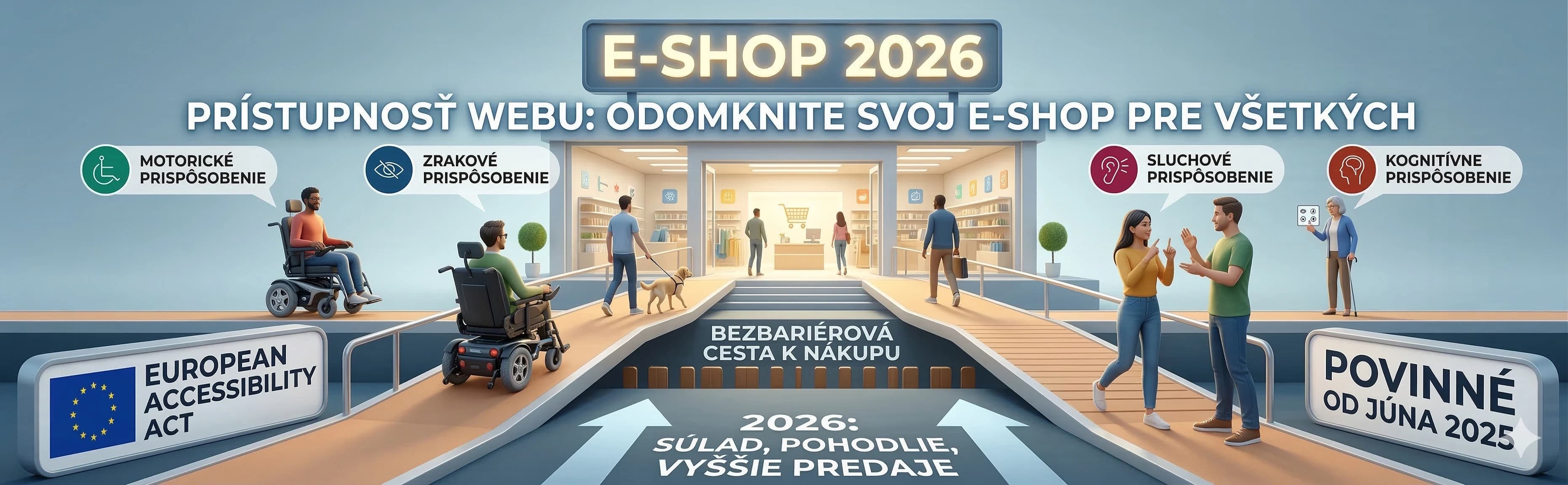
Web Accessibility in 2026: What Your Online Store Must Meet to Avoid Fines for Inaccessibility

The European Accessibility Act has been in effect since June 2025, and you cannot excuse yourself from fines by claiming you were unaware of it. If you are selling online to customers in the EU, your website must be accessible to people with disabilities. Here’s everything you need to know.
Web Accessibility in 2026: What Your Eshop Must Meet to Avoid Penalties for Inaccessibility
If you operate an eshop or any web service that sells to customers in the European Union, from June 28, 2025, a new reality applies to you. The European Accessibility Act (EAA) requires that your digital products and services be accessible to people with disabilities. This is not a recommendation. It is a law with real penalties.
And it is not about a marginal group of users. According to Eurostat, there are 101 million people in the EU, or one in four people over the age of 16, with some form of disability. Bird & Bird
A survey in Germany found that 75% of the most visited online stores were not accessible, and a similar study in Ireland revealed the same problem with 72% of well-known brands. Bird & Bird Every inaccessible eshop thus loses customers who simply cannot complete a purchase.
What is the European Accessibility Act and Who Does It Affect
The EAA comes into effect on June 28, 2025, and requires that all digital products and services sold in the EU be accessible to people with disabilities. The law applies to every business that sells in the EU, regardless of where it is located. Alokai
This means that if you have an eshop in Slovakia and sell to Slovak customers, the law applies to you. If you are based outside the EU but your customers are in Europe, the law applies to you as well. The EAA is compared to GDPR in terms of privacy protection. Just as GDPR changed how companies approach personal data, the EAA is changing the approach to digital accessibility globally. Americaneagle
Only micro-enterprises with fewer than 10 employees and a turnover of less than 2 million euros are exempt. Everyone else must act.
What Are the Penalties for Noncompliance
This is not a toothless law. Penalties vary by country but can reach up to 500,000 euros in Germany, between 5,000 and 300,000 euros in Spain, and between 5,000 and 250,000 euros in France, where public announcements of noncompliance are also a risk. Alokai
Regulators have several tools at their disposal: administrative fines, corrective orders with deadlines of 30 to 90 days to rectify issues, and in cases of repeated violations, withdrawal of services from the market or blocking of websites. Usablenet
Enforcement is already real. Just a few days after the law came into effect, French organizations representing the visually impaired notified four major retailers that their websites do not meet requirements and threatened with lawsuits if they do not rectify the issues by September 2025. ADA Title III
What Exactly Must Your Website Meet
The technical basis of the EAA is the European standard EN 301 549, which adopts the requirements of WCAG 2.1 at Level AA. All 50 criteria of WCAG 2.1 Level AA apply to eshops in full. It is not just about "most" or "some," but about all of them. Siteimprove
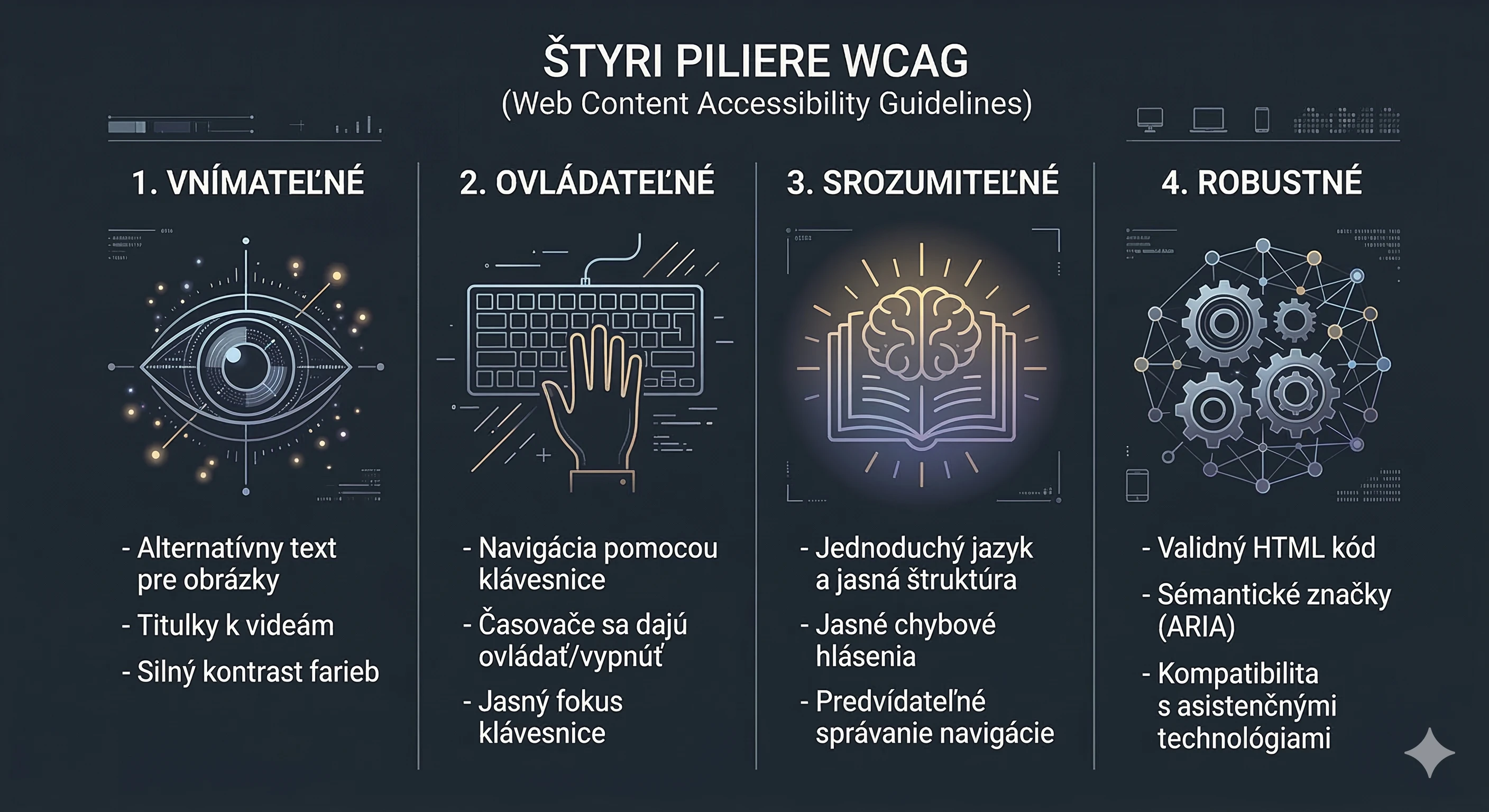
In practice, this means four key areas:
- Perceivability. All content must be perceivable to every user. Images must have descriptive alt text, videos must have captions, colors must not be the only way to convey information, and the contrast between text and background must meet a minimum ratio of 4.5:1.
- Operability. The entire website must also function without a mouse, purely via keyboard. Navigation must be logical and predictable, forms must have correctly linked labels, and interactive elements must be large enough for comfortable control. Alokai
- Understandability. Content must be clear and readable. Error messages in forms must specifically describe what is wrong and how to fix it. The language of the website must be correctly defined in the HTML code.
- Robustness. The website must reliably work with assistive technologies, primarily with screen readers. This requires semantically correct HTML, proper use of ARIA attributes, and heading structure without skipping levels.
Where Eshops Most Often Fail
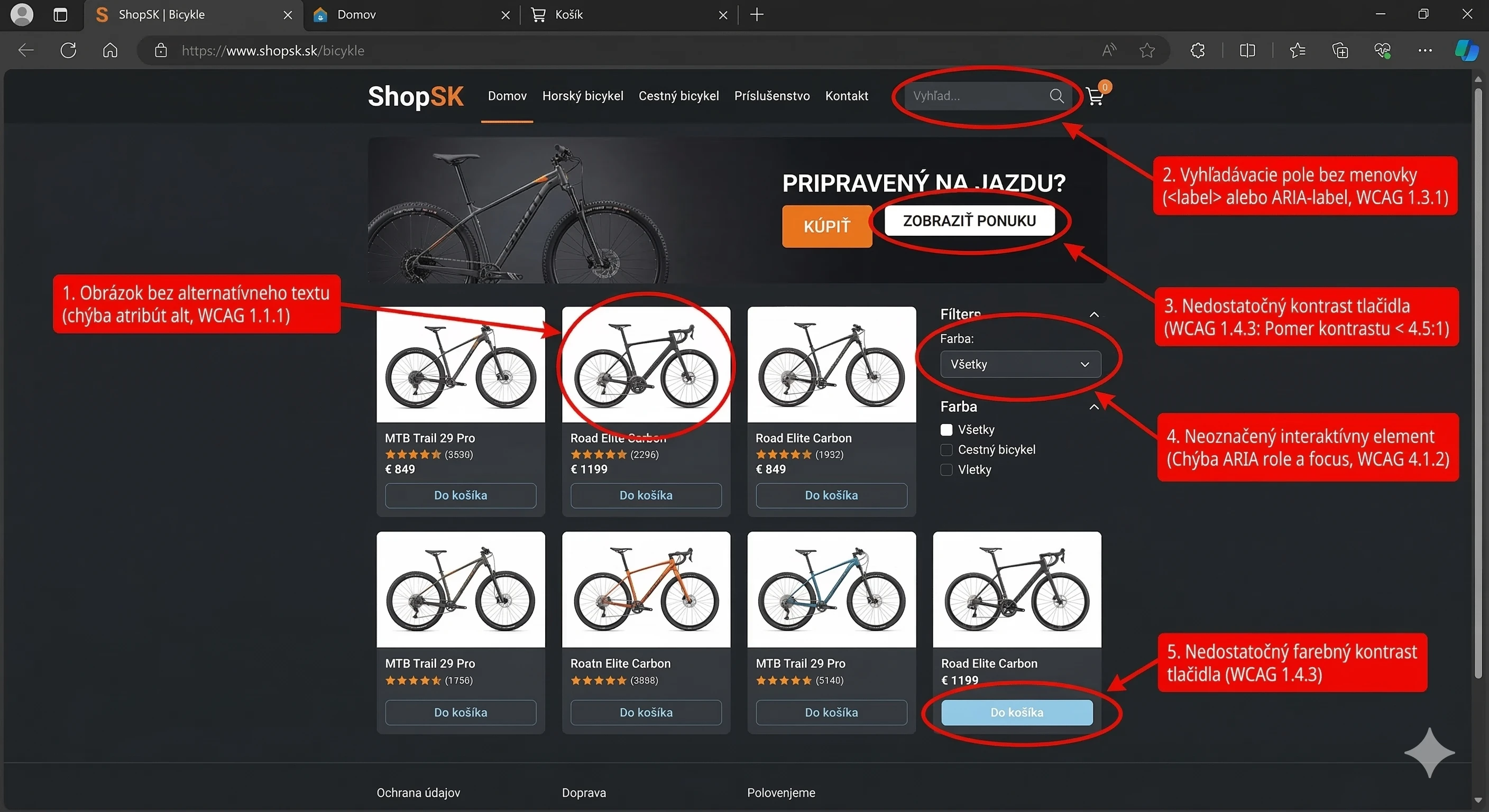
Most eshops in Slovakia are not accessible. Not because the owners are doing it intentionally, but because accessibility was not part of the assignment when creating the website. The most common problems:
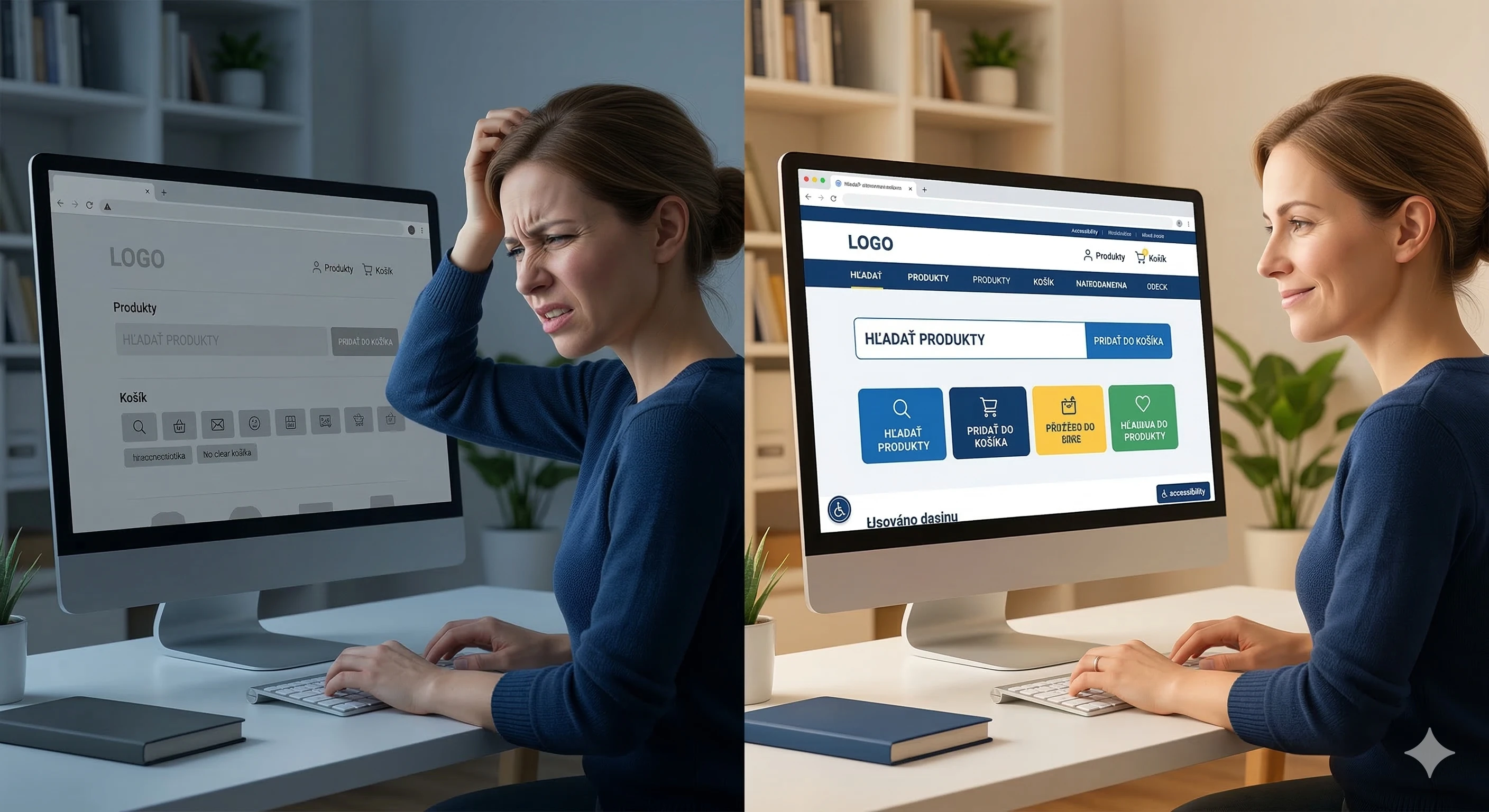
Product images without alt text. A screen reader cannot describe what is in the image, and a customer with vision impairment cannot distinguish products. According to AudioEye, up to 56% of images on corporate websites lack alt text Search Engine Land, which is one of the easiest fixable problems.
Shopping cart and checkout not operable by keyboard. Dynamic elements such as adding to cart, selecting a variant, or the payment form are often programmed to work only with a mouse.
Insufficient color contrast. Gray text on a light background looks "elegant," but for people with impaired vision, it is unreadable.
Missing labels in forms. Fields marked only with the placeholder "Your Name" disappear after clicking, and the screen reader does not know what the user should fill in.
Third-party integrations are also problematic. Payment gateways, recommendation engines, and marketing tools often introduce accessibility barriers to the website, and you are responsible for fixing them, not the plugin provider. Siteimprove
Accessibility and SEO: Two Sides of the Same Coin
Here comes the good news. Investing in accessibility is not just a cost for compliance. It is a direct gain for your SEO and conversions.
A SEMrush study on a sample of 10,000 websites found that websites meeting WCAG standards gained 23% more organic traffic and appeared for 27% more keywords than inaccessible websites. Accessibility
It is not a coincidence. Alt texts that help the visually impaired also help Google understand the content of images. The correct heading structure that facilitates navigation for screen readers also helps search engines understand the hierarchy of content. Fast loading and responsiveness, which are part of accessible websites, are directly measured through Core Web Vitals.
According to a study by the Nielsen Norman Group, websites meeting basic accessibility standards recorded a conversion increase of 8 to 12%, even among users without disabilities. Search Engine Land An accessible website is simply a better website for everyone.
How to Start: A Practical Procedure for Companies in Slovakia
Accessibility cannot be solved over a weekend. It is a process, not a one-time task. Here is a realistic procedure:
1. Audit of the current state. Start with an automated scan using tools such as Lighthouse, axe, or WAVE. These tools will reveal about 30 to 40% of the issues. The rest requires manual testing: try to go through the entire purchase process only using the keyboard, turn on a screen reader, and verify if you can complete the order.
2. Prioritization of fixes. Not all issues are equally serious. First, fix what prevents the completion of a purchase: forms, cart, checkout, payment. Then address navigation, product pages, and content.
3. Implementation of fixes. Most fixes require changes to the frontend: adding alt texts, correcting heading structures, supplementing ARIA attributes, adjusting contrast, and ensuring keyboard operability. For WordPress with Elementor, this is usually a combination of adjustments in the template and custom CSS/JS.
4. Accessibility statement. The EAA requires you to publicly publish an accessibility statement, in which you describe how your service meets accessibility requirements. Bird & Bird This statement must be available in both written and audio form.
5. Ongoing monitoring. Accessibility is not a state that is achieved once and for all. Every new page, every new product, every plugin update can introduce new barriers. Set up regular audits.

Why Address It with an Agency
Accessibility is a specific discipline at the intersection of UX design, frontend, and legislation. Most web developers in Slovakia do not have practical experience with WCAG audits, as it has not been a legal requirement until now.
An agency that understands both design and accessibility can incorporate the audit and repair into an existing redesign or as a standalone project. The result is a website that is not only legally compliant but also converts better, is better displayed on Google, and provides a better experience for all visitors regardless.
The European Commission emphasizes that inclusive online services allow businesses to reach a larger, mostly untapped market, and the EAA aims to facilitate this cross-border trade for both consumers and businesses. Bird & Bird

Conclusion: Accessibility is Not Charity, It’s Business
The EAA is not a bureaucratic duty that needs to be ticked off. It is a signal that the European Union takes digital inclusion as seriously as personal data protection. And just as with GDPR, it holds that companies that prepare in time will benefit from it. Those that wait for the first penalty will pay significantly more.
If you are unsure how accessible your website is, start with an audit. And if you need help with fixes, turn to a team that addresses accessibility not just as a technical requirement but as part of overall UX and SEO.