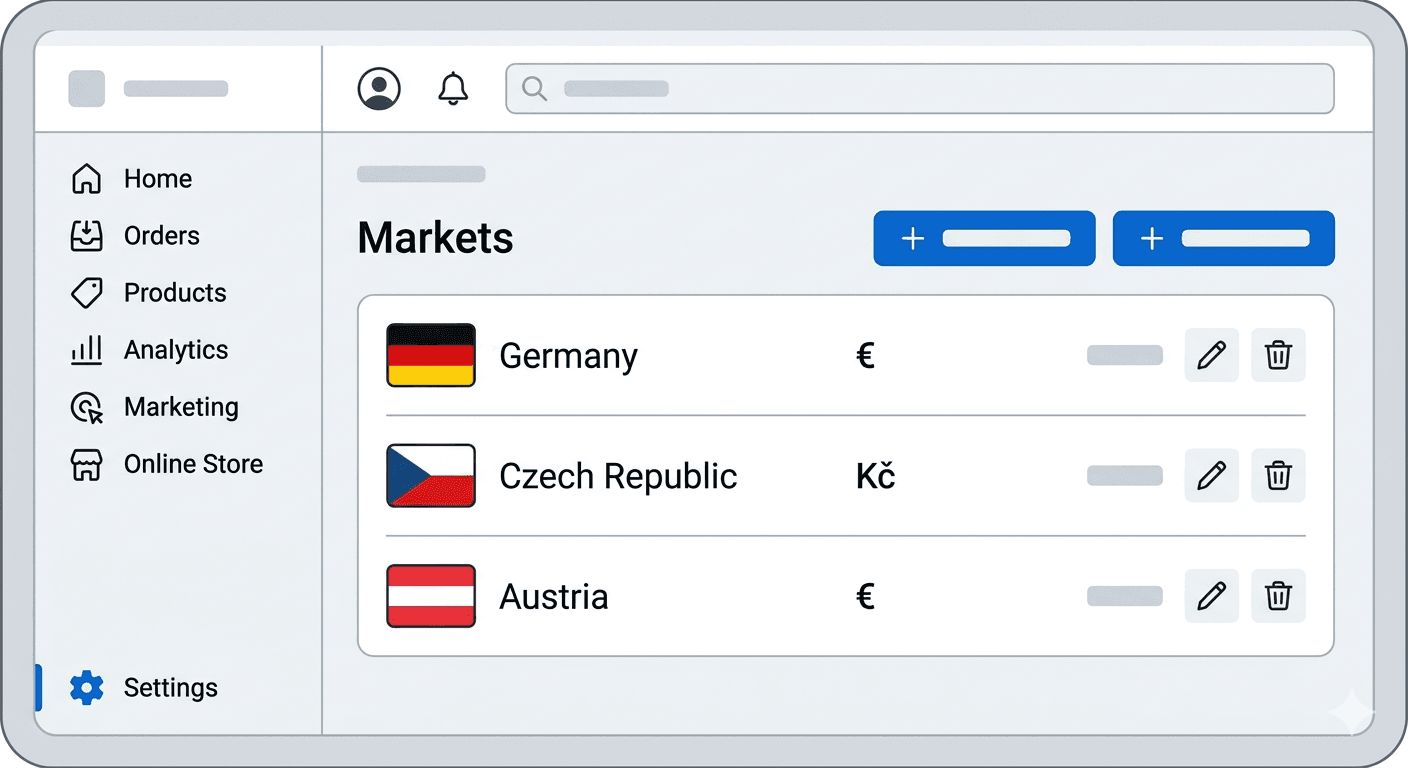
Shopify Markets vs. multi-store: How to properly go abroad?

One store for the whole world, or a separate e-shop for each market? A decision that will affect SEO, costs, and the team for years to come – and it's not as straightforward as it seems.
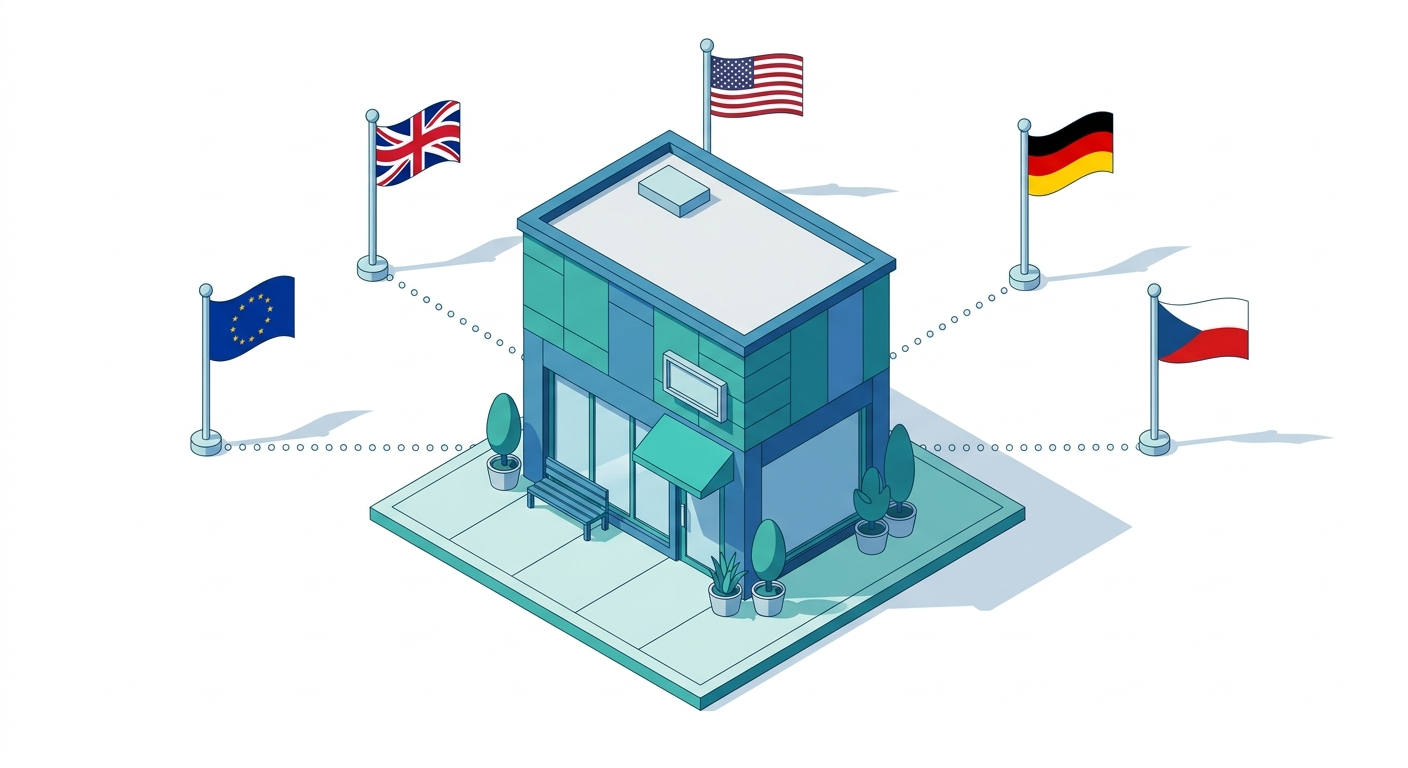
Shopify Markets vs. multi-store: How to properly expand abroad?
You want to sell to Germany, the Czech Republic, Austria, and Hungary. The question that someone will inevitably ask you sooner or later is: “Will we make this one store with Markets, or each market on its own shop?” Both paths are technically possible. Both are legitimate. And both have specific consequences for SEO, costs, speed of launch, and how many people you will need to involve in daily operations.
This article will not tell you which path is “better”—because that depends on your size, team structure, and business model. But it will help you accurately identify where each of them works and where it will get you into trouble.
What is Shopify Markets and what does it natively solve
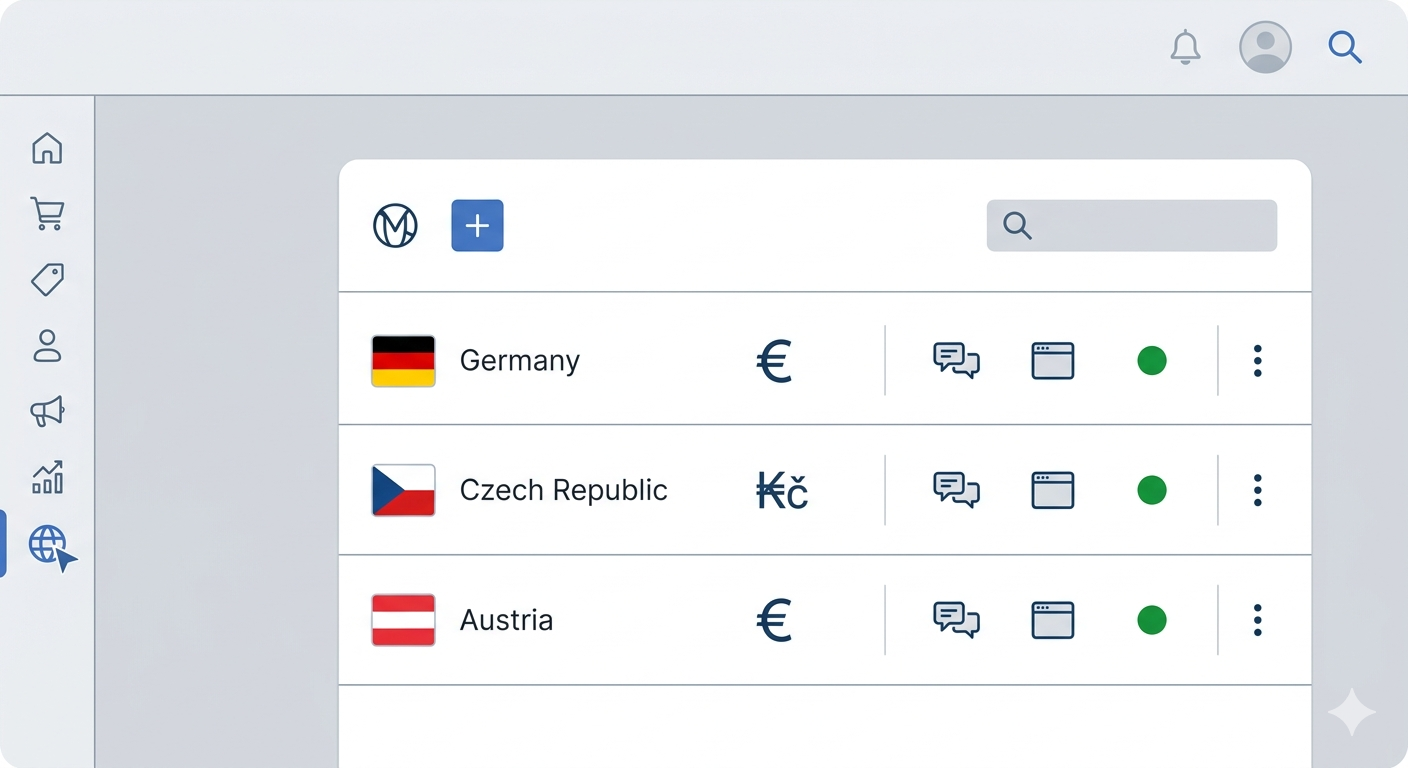
Shopify Markets is a feature that allows you to sell to multiple countries and regions from a single backend. Instead of managing five separate Shopify stores, you manage one, and set a separate currency, language, pricing, available products, and domain structure for each market.
What Shopify Markets natively solves:
- Currencies and local pricing — a customer from Slovakia sees prices in euros, a customer from Britain in pounds. The rates are automatically converted. If automatic conversion is not enough, you can set explicit fixed prices or percentage adjustments against the base price list for each market.
- Language versions — content translation is provided by the native app Translate and Adapt, or compatible third-party applications. Each market can have its own interface language and content.
- Domain structure — for each market, you can choose subfolder (
example.com/de/), subdomain (de.example.com), or a full local domain (example.de). Shopify recommends subfolders for maximizing SEO—more on that in the following section. - Taxes and customs — Shopify Markets allows you to show import fees and local taxes directly in checkout, eliminating unpleasant surprises at delivery.
- Product availability — each market can have its own selection of products. A product you sell in Germany might not be visible in Great Britain.
The basic version of Markets is available on all Shopify plans. Some more advanced features—such as granular pricing overrides or submarket logic—are available only on higher plans.
SEO and domain structure: Where Markets really shines
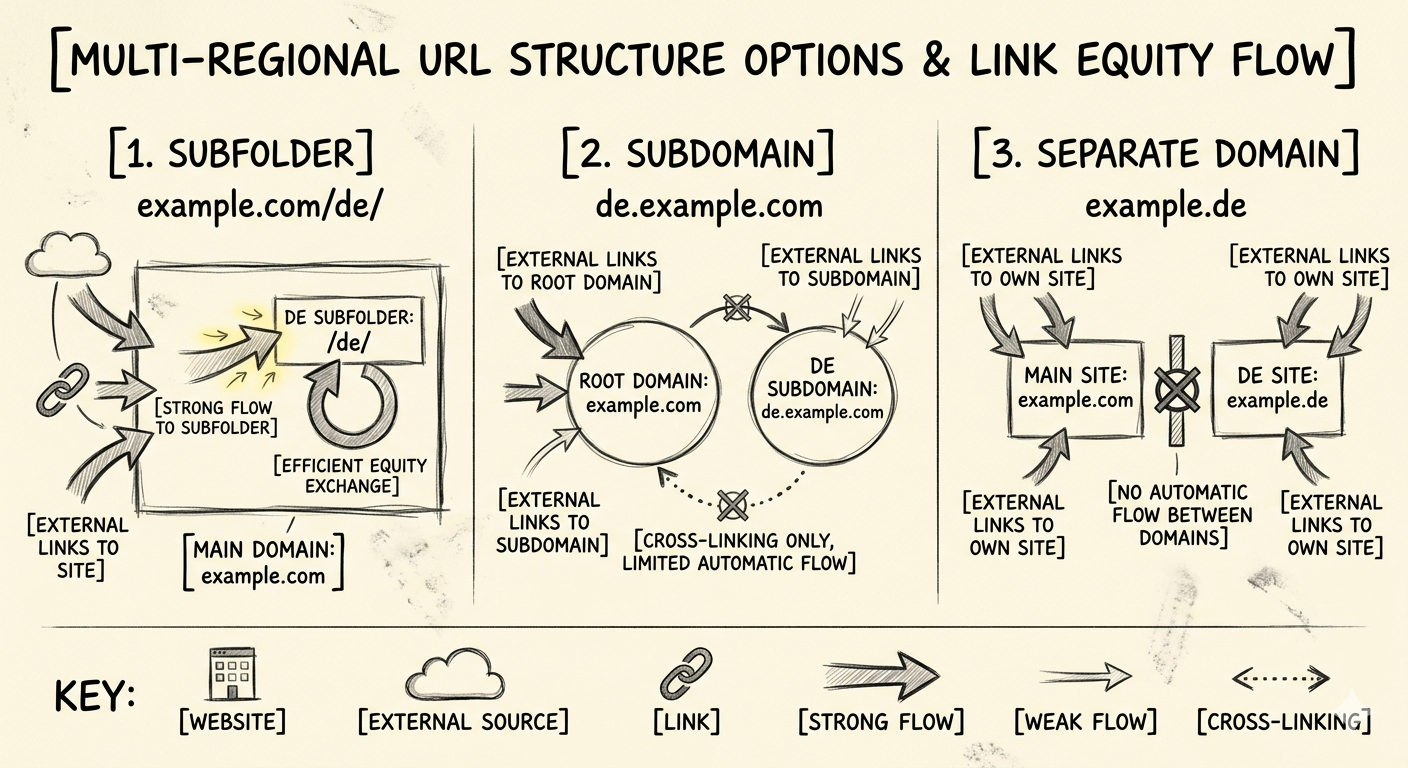
This is an area where Shopify Markets has a clear advantage over the multi-store approach—provided you set up the structure correctly.
- Automatic hreflang tags — Shopify automatically generates hreflang attributes for each market and language you activate. These tags signal to search engines which language version of the page is intended for which region, preventing duplicate content. Manually managing hreflang tags for multiple separate stores is time-consuming and error-prone.
- Subfolders as an SEO-optimal choice — according to Shopify and recommendations from the SEO community, subfolders (
example.com/de/) are more advantageous than subdomains because all domain authority is concentrated on the main domain. With a multi-store approach with separate domains, you lose this advantage—each store builds authority from scratch. - Sitemaps — Shopify automatically includes all language versions in sitemaps, which facilitates indexing for Google.
With separate expansion stores, you have to build SEO for each market completely separately. Backlinks from German media that point to example.de do not help your example.com. With the Markets approach, the situation is reversed.
Where Shopify Markets hits limits
Now to the things that Shopify marketing materials do not emphasize too much.
- Currency conversion fee: 1.5% — every transaction made in a currency other than the store's primary currency incurs a 1.5% conversion fee. With a turnover of 500,000 EUR per year in foreign currencies, that amounts to 7,500 EUR per year just in conversion fees. For high-volume merchants, this can be a case for expansion stores with local payers.
- Dependence on Shopify Payments — multi-currency selling through Markets requires Shopify Payments. If Shopify Payments is not available in your region, or if you prefer another payment provider for business reasons, this is a significant limitation.
- Discounts are global — this is a real issue for merchants who want to run regional campaigns. Shopify does not natively allow the creation of a discount code valid only for a specific market. A discount you activate for Black Friday in the Czech Republic also works in all other markets—unless you solve it with a third-party application or your own logic through Shopify Functions.
- Collections and homepage are global — the structure of collections and homepage content applies across all markets. If you want to show completely different navigation or a different selection of featured products to German customers than to French ones, you will run into limits on what is configurable per market. Partially, this is addressed by metafields and Markets API, but not without developer intervention.
- App compatibility — not all third-party Shopify apps are fully compatible with Markets. It is essential to verify the entire app stack before migration.
Multi-store architecture: When it makes sense
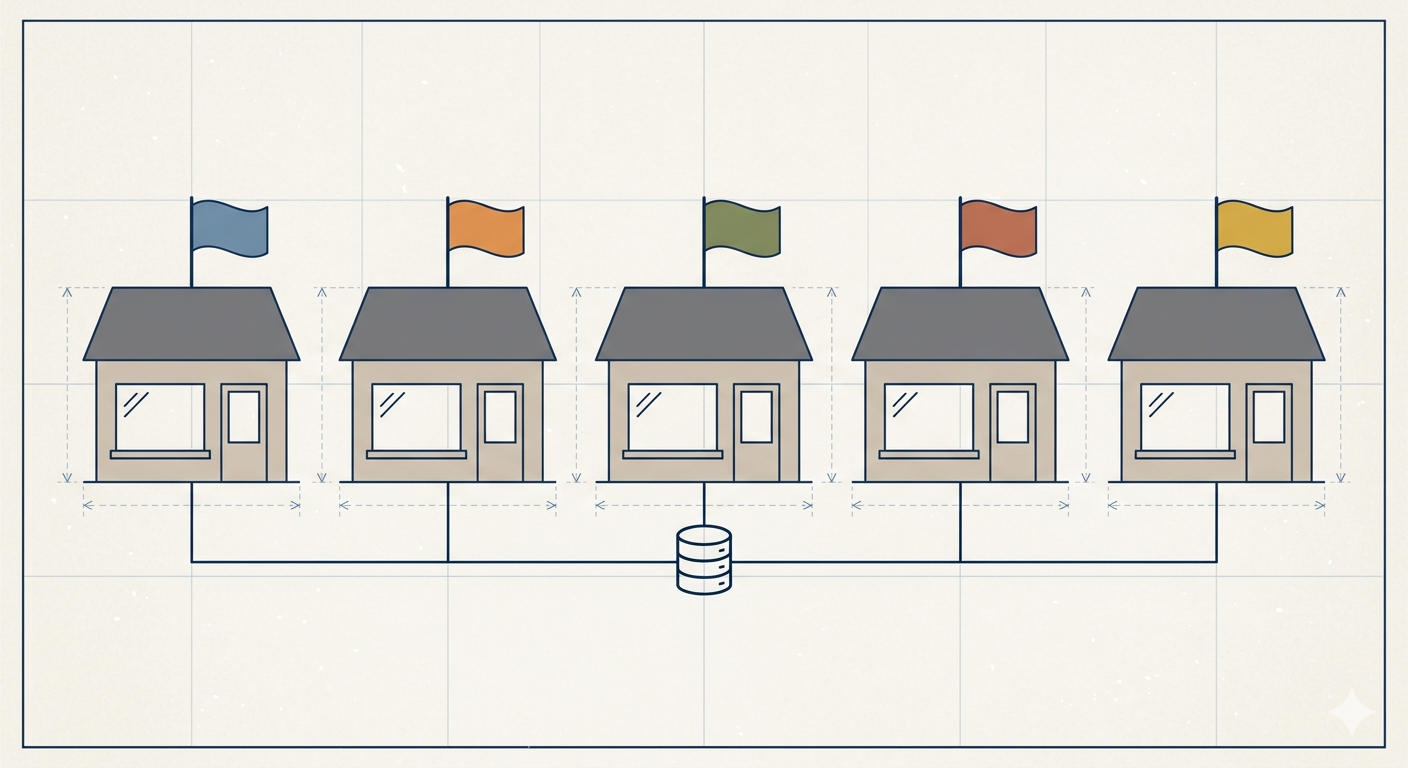
Shopify Plus allows managing a main store and up to 9 additional expansion stores within a single organization at no extra cost. Each additional store beyond this limit costs 300 USD per month.
Expansion stores are technically completely separate Shopify instances—own products, orders, customers, analytics, and payment settings. Centralized management is only for user management and invoicing at the organization level.
When multi-store architecture makes sense:
- Regional autonomy required by the business model — if each market has its own local team needing full control over assortment, pricing, campaigns, and customers, the expansion store gives each team that space without the risk of overwriting settings.
- Handing over market to a local partner — if you expand through a distribution partner in Hungary and want to give them full access to the shop without letting them see the rest of your operation, an expansion store is a clean solution.
- Separate payment entities — some companies need to invoice from different legal entities in various countries. Markets does not support this—each expansion store can have its own bank connection and payment entity.
- Radically different assortment or brand — if your German shop is for B2B and your Slovak shop is for B2C, or if you sell under different brands in different countries, a common backend can be limiting rather than beneficial.
- High volume of transactions in foreign currencies — with sufficient turnover, saving on the 1.5% conversion fee can cover the costs of an expansion store.
Hybrid approach: One core, several separate markets
This is a solution increasingly chosen by mid-market and enterprise merchants—and it is also the recommended approach from Vervaunt and other Shopify partners.
Typical model: Markets for smaller or less complex markets (for example, all CEE countries in one store), expansion stores for key markets with high turnover or specific requirements (for example, Germany and Great Britain as separate instances).
This approach combines the benefits of both worlds—centralized management for the majority of markets and full flexibility where needed.
Downside: it requires a well-designed data architecture. The product catalog, pricing, and customer data must be consistently synchronized across all instances—which typically means integration with a PIM system or ERP.
Real-world example: Two companies, two decisions
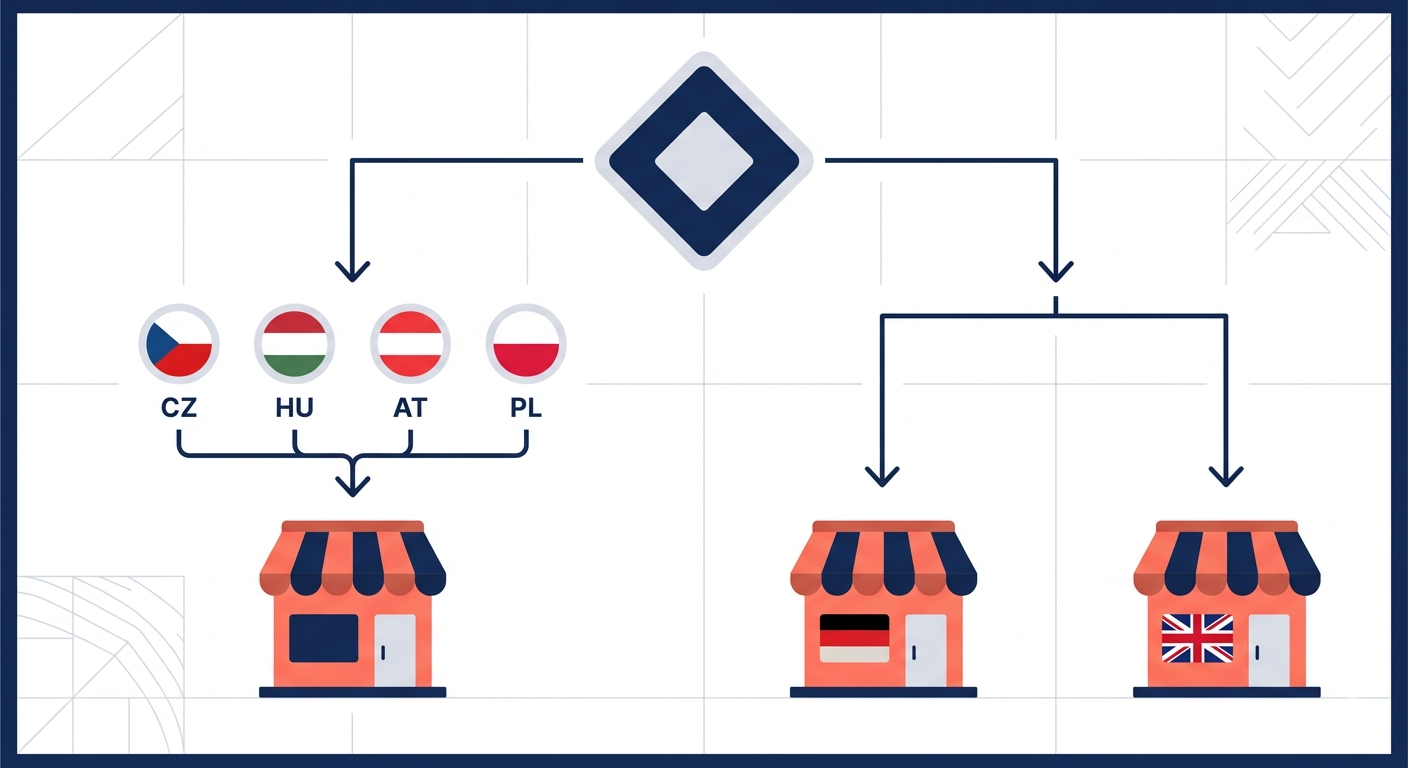
Company A — a fashion shop based in Slovakia, expands to the Czech Republic, Hungary, and Austria. The assortment is identical, the team is central, regional campaigns are minimal. Here, Markets is a clear choice: one backend, three localizations, automatic
hreflang, no duplication of product information.
Company B — a technology distributor with a Slovak, German, and British market. Germany has its own team, a different assortment, and a local financial partner. The UK requires a separate payment entity post-Brexit. Here, the right decision is: the Slovak and Czech markets through Markets, Germany and the UK as expansion stores.
Both companies could have done the opposite—but at the cost of unnecessary complexity or limitations.
Common mistakes in decision-making
“Markets is always easier” — it is easier to launch, but not always to operate. If your team is running regional campaigns with different discounts and needs granular control, you will hit limits sooner than you expect.
Ignoring conversion fees when scaling — 1.5% is negligible at a 50,000 EUR turnover. At 2 million EUR, it is 30,000 EUR per year. Make this calculation before making the decision, not after.
Launching without auditing the app stack — before switching to Markets, check the compatibility of every application your store relies on. Some key tools (loyalty programs, upsell applications, review systems) may not function correctly across markets.
Expansion stores without a central PIM — if you manage 5 separate stores without a central system for product data, every change in description or photo means five times the work. This is the most common reason why companies consolidate back to Markets over time.
Undervaluing the SEO difference — an expansion store on a new domain starts with zero authority. If you have existing SEO strength, moving products to a new domain without proper migration can erase years of building organic traffic.
Conclusion: The question is not “what is better,” but “what do we need now and in three years”
Shopify Markets is the right choice for most merchants expanding into several countries with a central team and relatively uniform assortment. It is faster to launch, cheaper to operate, and better for SEO—as long as its limits (global discounts, dependence on Shopify Payments, app compatibility) do not hinder your model.
Expansion stores make sense where regional autonomy, separate payment entities, or a different brand require complete separation. And the hybrid approach—Markets for smaller markets, expansion stores for key ones—is becoming an increasingly common choice for merchants in the growth phase.
If you are planning international expansion and want to go through specific scenarios of your situation before making a decision, we would be happy to look into it together.

Selected projects
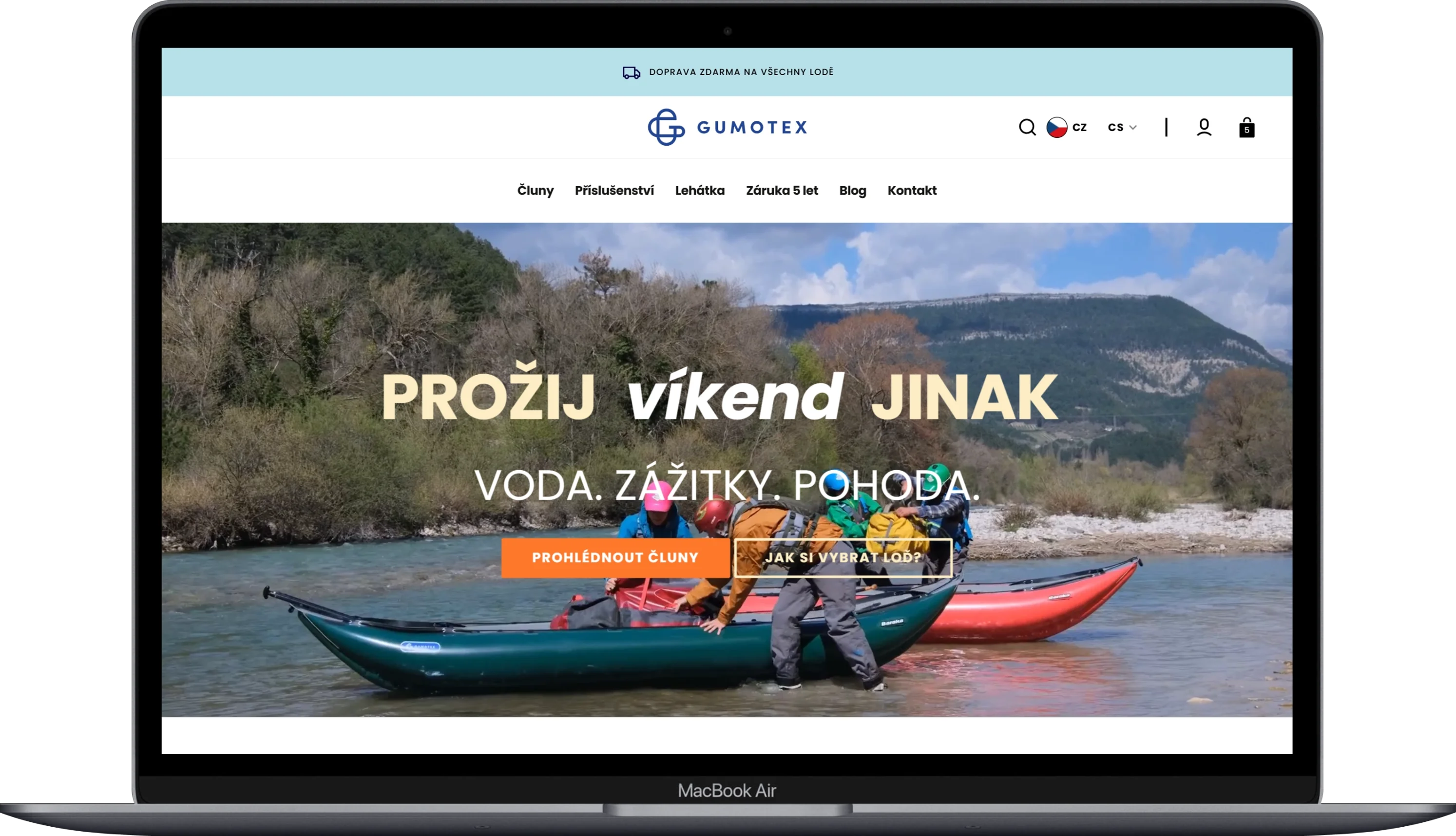
Gumotex
Category
E-commerce
Client
GUMOTEX Coating s.r.o.
Duration
3 months
Dr. LUCULLUS
Category
Custom Development
Client
Dr. Lucullus MEDICAL
Duration
March 1, 2025 - present

GUMIDECK - Eshop
Category
E-commerce
Client
GUMIDECK
Duration
2 weeks

Pneugrup - e-shop
Category
E-commerce
Client
Pneuservis pod rondlom
Duration
2 months