Multilingual e-shop: how to manage SK/CZ/EN without chaos

Expanding to the Czech Republic or abroad through an e-shop? Learn how to properly set up languages, prices, and products – and avoid the mistakes that cost customers.
Multilingual e-shop: how to manage SK/CZ/EN without chaos
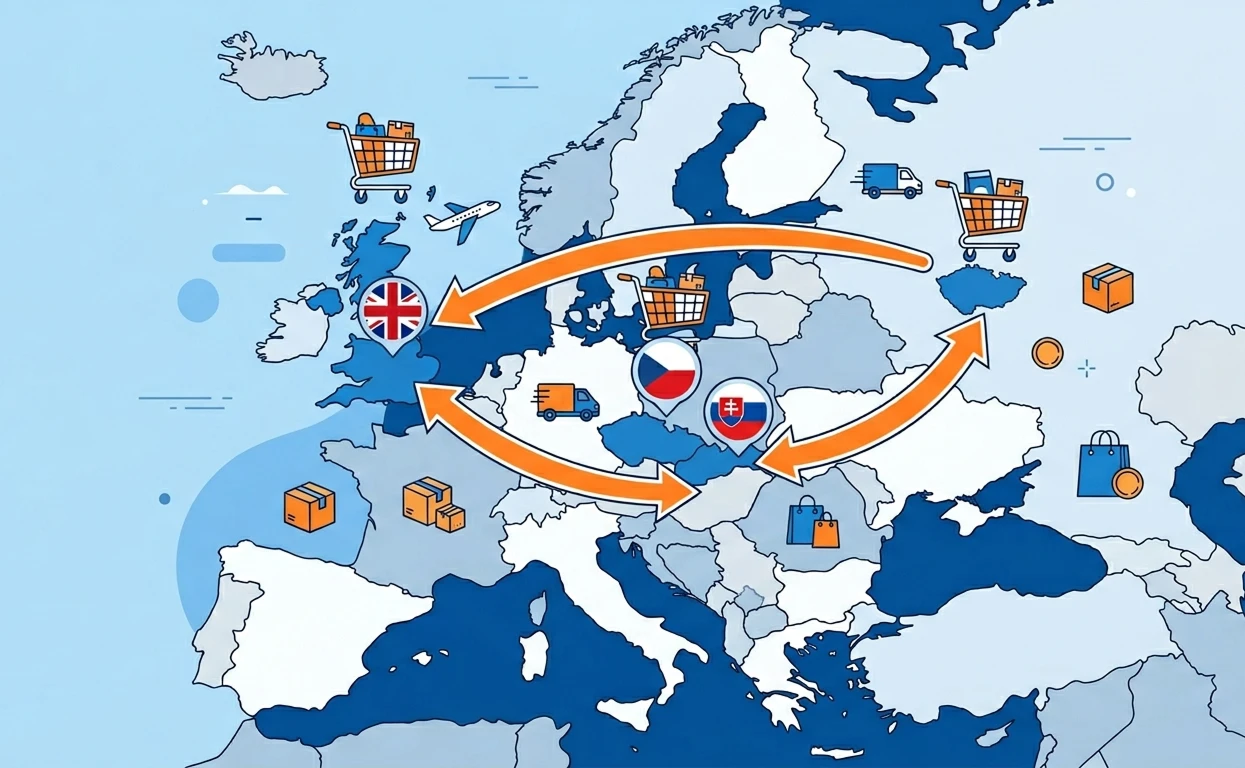
You have an e-shop that operates in Slovakia. Customers are satisfied, revenues are growing – and orders are starting to come in from the Czech Republic. Or you want to actively expand. In any case, you are facing a decision that many e-shop owners underestimate: a multilingual e-shop is not just about "translating texts". It is a different technical architecture, different SEO, different prices, and different customer service.
If you do it hastily, you'll end up with a confused Google, duplicate content, and customers who do not know what currency they are paying in. If you do it right, you will open up markets without having to launch an entirely new e-shop.
Why translating texts alone is not enough
This is the most frequent misconception: “We’ll put it in a translator, set up the Czech flag, and it’s done.”
The problem is that the correct multilingual e-shop must address these levels simultaneously:
- Language – texts, categories, product descriptions, email notifications, checkout, error messages
- Currency – CZK, EUR, GBP separately for each market, ideally with real-time rates or fixed prices
- Prices – the same price in EUR and CZK does not mean the same purchasing power; markets have different price elasticity
- SEO – each language needs its own URLs, its own meta descriptions, and hreflang attributes
- Logistics – shipping rates, delivery times, returns
According to Common Sense Advisory (now Nimdzi), up to 75% of customers prefer to shop in their native language and 60% of them rarely or never buy from a website that is only in English. Translation is not a luxury – it is fundamental for a foreign customer.
Three main approaches to multilingualism
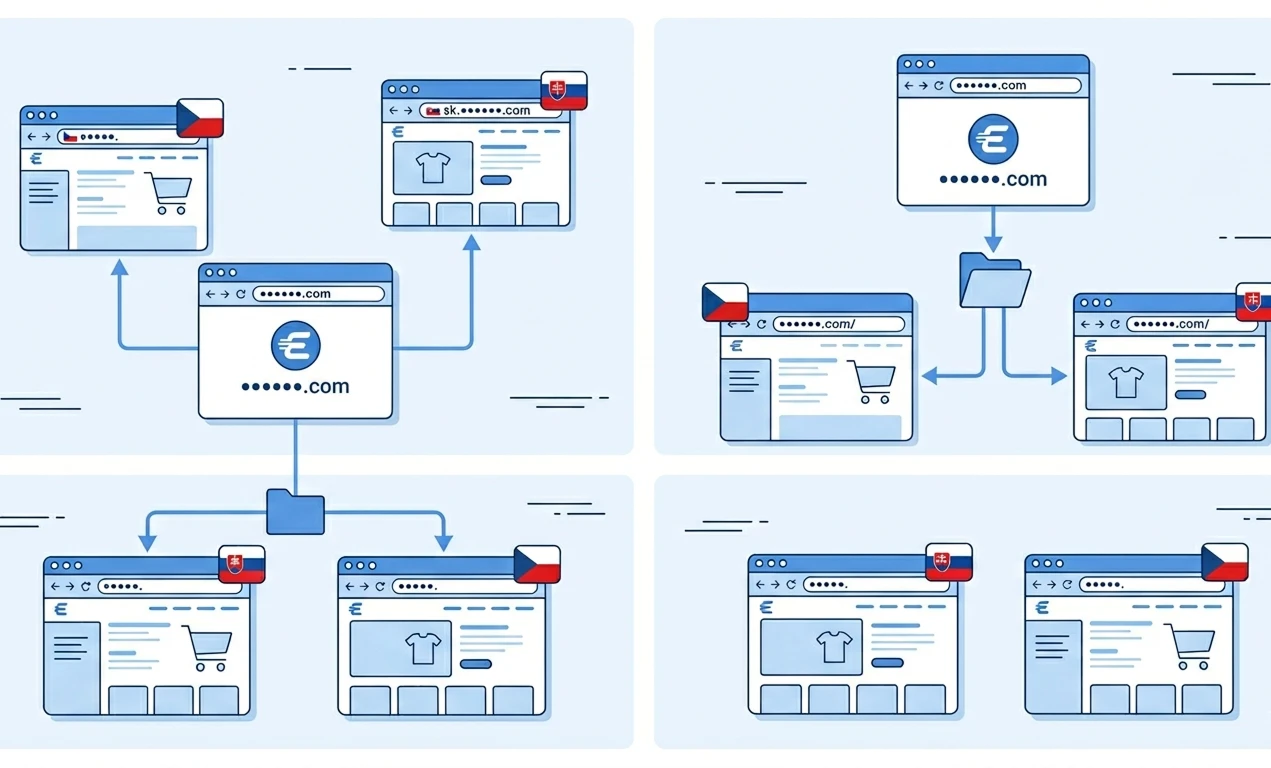
Before choosing the technology, you must select a URL strategy. It has a direct impact on SEO:
1. Subdomains (cs.mojeshop.sk, en.mojeshop.sk) Each language version has its own subdomain. Google perceives them as separate websites – building authority takes longer, but it clearly separates markets. Suitable if the languages have distinctly different assortments.
2. Subdirectories (mojeshop.sk/cs/, mojeshop.sk/en/) Recommended approach according to Google Search Central documentation. The entire site shares domain authority, language versions are clearly separated, and hreflang tags work reliably.
3. Separate domains (mojeshop.cz, mojeshop.com) The most distinct local trustworthiness (.cz domain for Czechs appears more trustworthy). More costly to manage and build SEO – each domain starts from scratch.
Recommendation for SK/CZ expansion: Subdirectories or a separate .cz domain, depending on how large the planned Czech expansion is.
Platforms: how to technically solve it
Choosing a platform significantly affects how hard (and expensive) multilingualism will be to implement.
Shopify + Shopify Markets
Shopify Markets is a native feature for international expansion – you manage more markets from one admin, setting prices, currencies, and languages for each market individually. For SK/CZ e-shops on Shopify, it is now a standard solution.
What works well: currency conversions, language URLs, localized checkout
What needs to be addressed additionally: professional translation (machine translation is not enough for product descriptions), setting up local payment methods (Czech Twisto, Gopay)
WooCommerce + WPML or Polylang
On WordPress, multilingualism is solved through plugins. WPML is the most popular, but it adds technical complexity and slows down page loading under incorrect configuration. For larger e-shops (1,000+ products), we recommend checking the performance audiovisually before expansion.
Custom solution (Next.js + headless CMS)
For e-shops with complex requirements (B2B portals, specific pricing logic, integration with ERP), headless architecture with a custom backend is the most flexible solution. More expensive to start, but the best long-term scalable.
SEO for multilingual e-shop – what you must not neglect
This is a technical area where mistakes cost organic traffic. Three critical things:
1. Hreflang tags Inform Google which language version belongs to which region. Without them, Google will choose which version to display – and usually chooses incorrectly. Each page must have hreflang for all language variants including x-default.
html
<link rel="alternate" hreflang="sk" href="https://mojeshop.sk/sk/produkt/" />
<link rel="alternate" hreflang="cs" href="https://mojeshop.sk/cs/produkt/" />
<link rel="alternate" hreflang="x-default" href="https://mojeshop.sk/sk/produkt/" />
2. Localized content, not just translated The Czech customer does not search for the same phrases as the Slovak customer. “Shoes” vs “boty”, “mobile” vs “telefon”. Translating keywords must be part of the SEO strategy for each market.
3. Canonical URLs If there are multiple versions of the same page (for example, product page in SK and CZ), each must have the correct canonical tag. Without this, Google considers the content duplicated and penalizes both versions.
Prices and currencies – an undeniable detail
Setting prices for multiple markets is not just a currency conversion. Customers in the Czech Republic are used to prices in CZK and psychological price points work differently: 999 CZK feels different than 39.99 EUR, even though it’s the same amount.
Shopify study on checkout optimization shows that displaying prices in the local currency increases the conversion rate by an average of 12%. For high-volume e-shops, this is a significant difference.
Additionally: if you sell into the EU, you must monitor OSS (One Stop Shop) for VAT – from July 2021, there is an obligation of VAT registration under the rules of the European portal once the threshold of €10,000 annually from sales to other EU countries is exceeded.
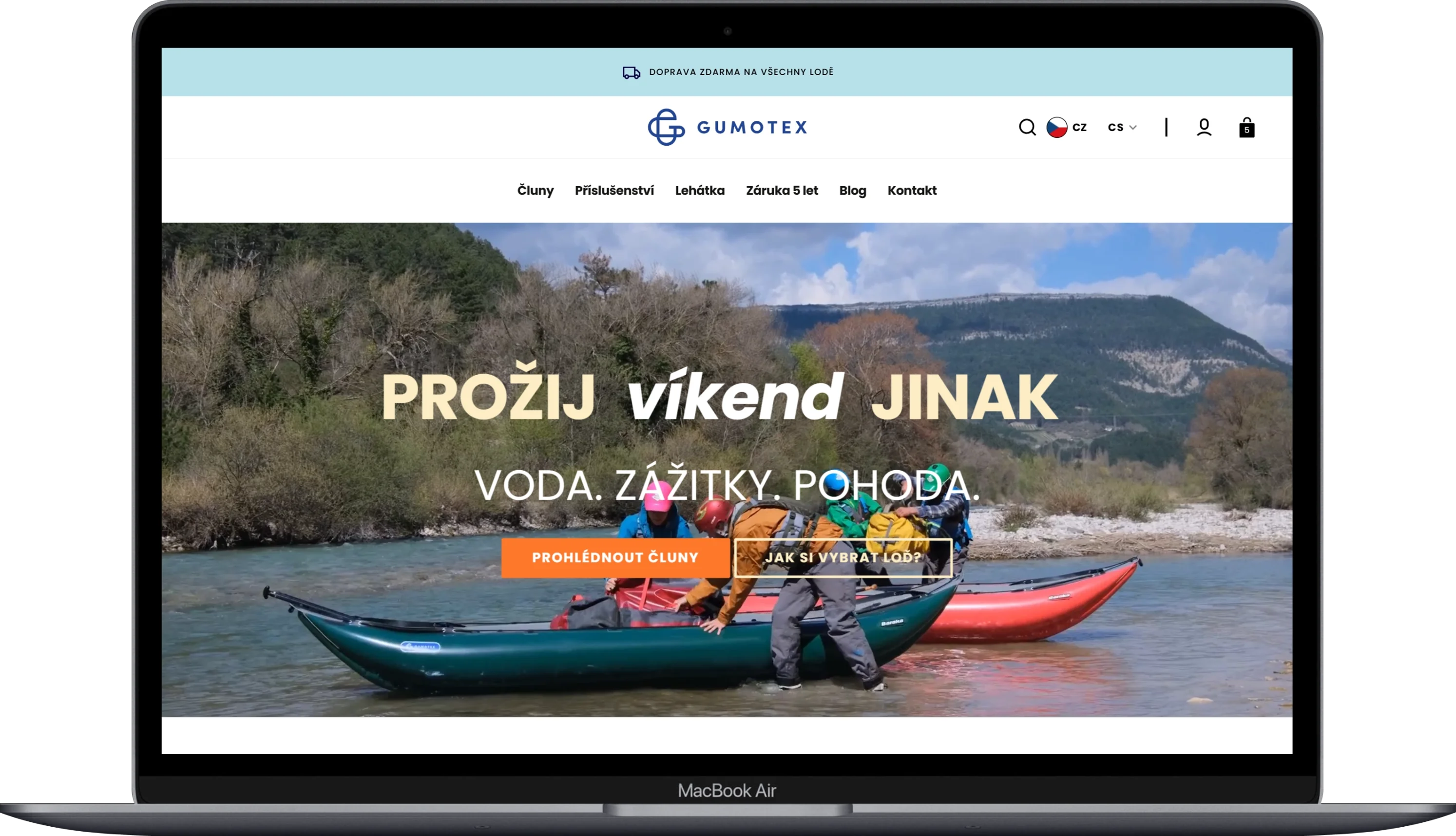
Example from practice: GUMOTEX Boats – migration from WooCommerce to Shopify + expansion across the EU
GUMOTEX Boats is a European giant in inflatable boats, kayaks, and water accessories. When they came to us, they had a problem that many e-shop owners know: the existing WooCommerce solution was technically inadequate – neither in performance nor in its ability to cover international sales at the level that a premium brand required.
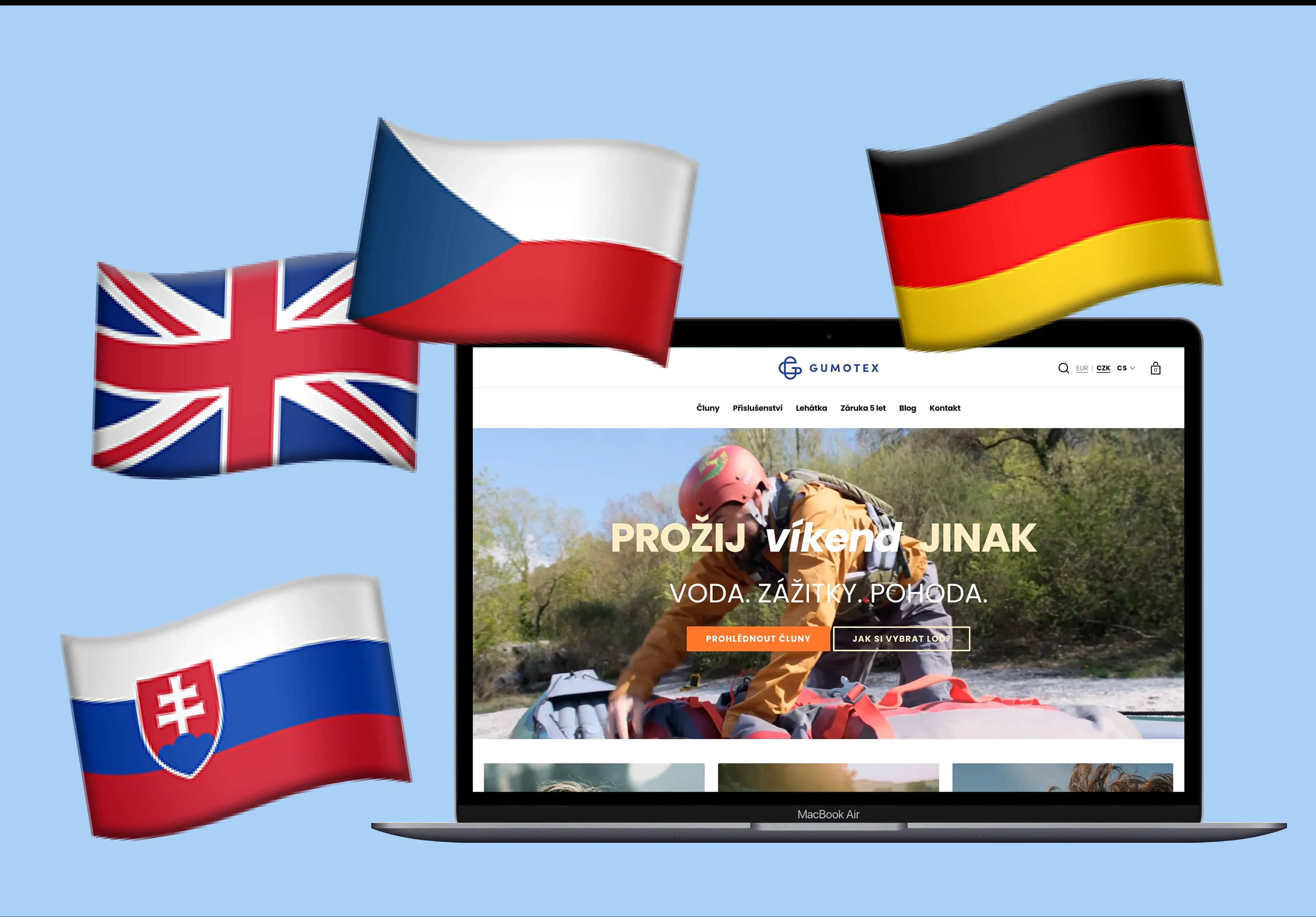
We migrated the entire e-shop from the non-functional WooCommerce to Shopify and simultaneously launched an expansion to most EU countries. The e-shop operates in three languages (Czech, English, German) and covers an extremely heterogeneous assortment – from valves costing a few euros to expedition boats costing several thousand.
Key decisions: We configured Shopify Markets so that each market had the correct language, currency, and transport rules including VAT and customs conditions for individual countries. We did not use machine translation – each language version was handled by a translator with a marketing background. Hreflang tags were set via XML sitemap for all language variants.
The result is a robust, visually strong business tool that can handle the commercial complexity of selling across the entire EU – and a customer from Germany, the Czech Republic, Poland, Latvia, Italy (and I could go on...) has a fully-fledged shopping experience in their language and currency.
Conclusion
A multilingual e-shop is an investment, not an expense – if done right. Poorly set hreflang tags, low-quality translation, or ignoring local payment methods can sabotage the entire expansion.
If you are planning to expand your e-shop to the CZ or EN market and want to avoid costly mistakes, contact us – we will propose an architecture that scales from day one.



Selected projects
Gumotex
Category
E-commerce
Client
GUMOTEX Coating s.r.o.
Duration
4 months
CapraKolostrum
Category
Custom Development
Client
CapraKolostrum
Duration
6 weeks
Petmiska
Category
E-commerce
Client
Next Point Company s. r. o.
Duration
2 months
Dr. LUCULLUS
Category
Custom Development
Client
Dr. Lucullus MEDICAL
Duration
March 1, 2025 - present