
SEO for Small Businesses in Slovakia: A Complete Guide from Basics to Advanced Strategies

SEO is not magic or a one-time affair. It is a systematic process that opens doors to organic traffic for small businesses in Slovakia without relying on paid advertising. This guide will take you from the very basics to advanced technical strategies.
SEO for small businesses in Slovakia: a complete guide from basics to advanced strategies
Let's get straight to the point. If you are a small business in Slovakia and your website is not appearing on the first page of Google, you simply do not exist for most potential customers. This is not an exaggerated statement. It is the market reality where Google covers approximately 95% of all searches. And that is precisely why SEO is one of the most important tools you have at your disposal. Not because it's a trendy term, but because it can bring you customers without you having to pay for every click.
This article is written to be useful for beginners as well as for those who are already oriented in the field and are looking for specific technical recommendations for the Slovak market.
What is SEO and why the term "seo optimization" does not make sense
Let’s start with the basics. SEO is short for Search Engine Optimization, i.e., optimization for search engines. It consists of a set of processes and techniques that ensure your website is understandable, relevant, and trustworthy for Google.
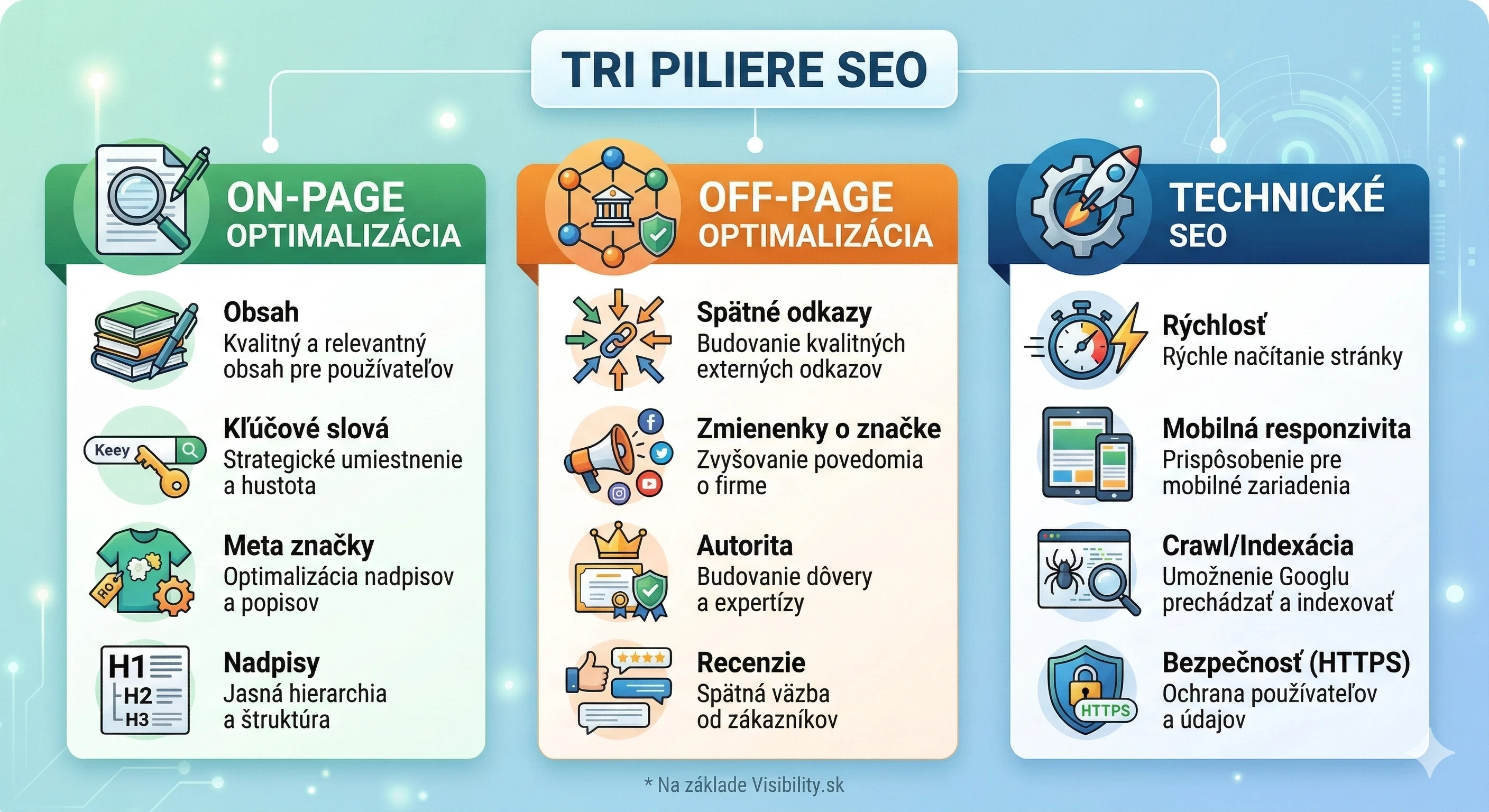
According to the portal Visibility.sk, SEO covers three main areas:
- on-page optimization (content and structure of the page)
- off-page optimization (backlinks and external signals)
- technical SEO (speed, crawlability, indexing)
And now to why the term seo optimization probably haunts you on every kind of website. When you break down this expression, you get "optimization of optimization for search engines." It's a pleonasm, meaning a redundant repetition of the same meaning.
SEO itself already contains the word "optimization." Nevertheless, this term is commonly used in Slovakia because people naturally search for "seo optimization," and for many, it’s a colloquial expression. From an SEO strategy perspective, it makes sense to use this term because people are searching for it. However, from a professional language standpoint, it’s good to know that the correct form is simply "SEO" or "optimization for search engines."
How Google actually works: crawling, indexing, and ranking
Before you dive into any optimization, you need to understand how Google works. The whole process has three phases.
The first phase is crawling, i.e., browsing the web. Google uses a so-called Googlebot that systematically visits websites and discovers new URLs through links and XML sitemaps. Each website has a designated so-called crawl budget, which is a limited number of pages that Googlebot visits on your website during a single visit. For small websites, this is usually not a problem, but if you have dozens of useless URLs on your site (such as duplicate parameters, empty pages, or test subpages), you are unnecessarily wasting this budget.
The second phase is indexing. Googlebot analyzes the content of the page, understands its structure and topics, and stores it in a massive index. If your page is not indexed, it simply won’t appear in search results. You can check your website's indexing status in the Google Search Console, a free tool directly from Google that should be the first step for anyone serious about SEO.
The third phase is ranking, i.e., evaluation. Google evaluates which pages are most relevant for a given search query based on over 200 signals, and ranks them. And influencing this order is the essence of all SEO.
Google Console: your first and most important tool
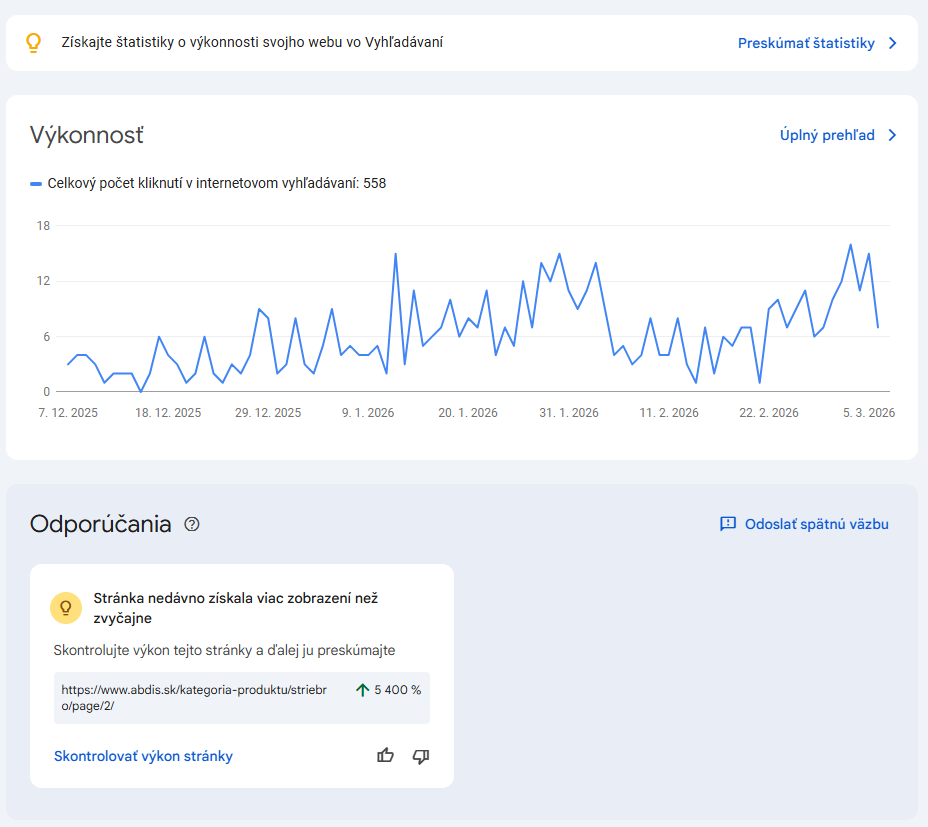
If you haven’t worked with Google Search Console until now, it’s high time to change that. Google Search Console (formerly known as Google Webmaster Tools) is a free tool that gives you direct insight into how Google sees your website.
What exactly will you find in it?
In the "Performance" section, you can see which search queries your website appears for, how many times people clicked on it, and what the average CTR is (click-through rate).
In the "Coverage" section (now "Pages"), you will find out how many of your pages are indexed and whether some are having issues.
In the "Core Web Vitals" section, you will see how your website scores on speed and user experience metrics.
For small businesses in Slovakia, Google Search Console is an invaluable tool because it allows you to make decisions based on real data rather than estimates. As mentioned by EcommerceBridge.sk, a combination of Google Search Console with tools like Collabim or SEMrush covers most analytical needs of small businesses in the Slovak market.
Ranking factors: what really impacts your positions
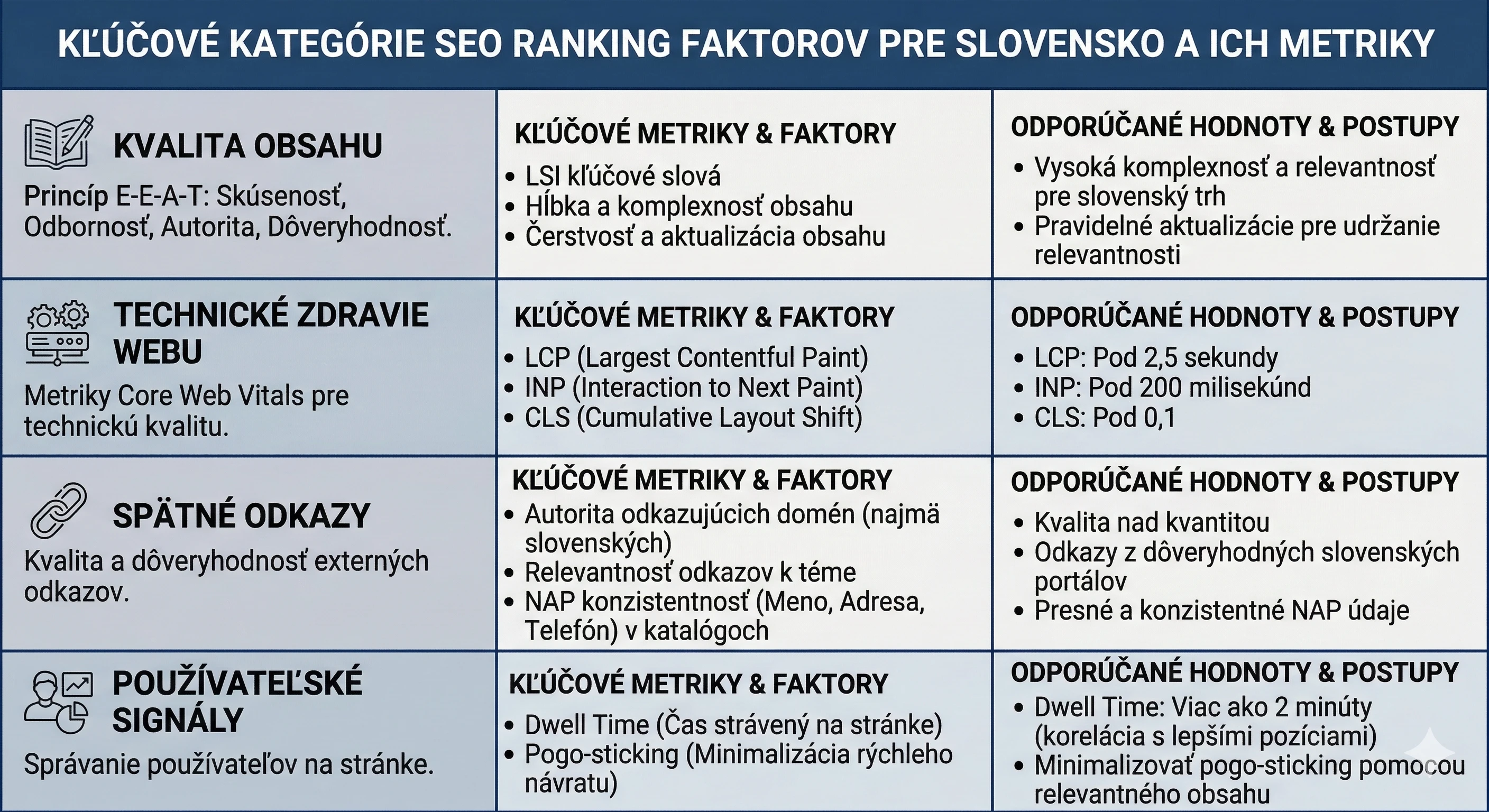
Talking about 200+ ranking factors can seem overwhelming. Let's break them down into four main categories that are relevant for small businesses in Slovakia.
The first category is content quality. Google evaluates content based on the E-E-A-T principle, which stands for:
- Experience,
- Expertise,
- Authoritativeness
- Trustworthiness.
For the Slovak market, this specifically means that Google prioritizes comprehensive content in Slovak over superficial pages. According to an analysis by Ebpearls, depth and freshness of content together with so-called LSI keywords (semantically related expressions) significantly affect page rankings.
The second category is the technical health of the website. Core Web Vitals are three metrics Google uses to evaluate the technical quality of a page.
- LCP (Largest Contentful Paint) should be under 2.5 seconds, measuring how quickly the main content of the page loads.
- INP (Interaction to Next Paint) should be under 200 milliseconds, measuring the responsiveness to user interaction.
- CLS (Cumulative Layout Shift) should be under 0.1, measuring the visual stability of the page during loading. According to SEOSolved, up to 70% of Slovak traffic comes from mobile devices, and slow pages see a decline in ranking of up to 20%.
The third category is backlinks. Quality outweighs quantity. One link from a trustworthy Slovak portal is worth more than dozens of links from unknown foreign sites. Consistency of NAP data (Name, Address, Phone) across directories like Zlaté Stránky is, according to Consultee, crucial for local SEO.
The fourth category is user signals. Dwell time (the time spent on the page) longer than 2 minutes correlates with positions that are approximately 15% better according to AllIAI. On the other hand, the so-called pogo-sticking (when a user clicks on a result, quickly goes back, and clicks on another) signals to Google that your page did not provide a relevant answer.
Technical SEO: the foundation without which content is insufficient
Technical SEO is an area where many small businesses in Slovakia get lost because it seems complicated. In reality, it is a set of specific steps that ensure that Google can effectively crawl and index your website.
Let's start with the robots.txt file. It is a simple text file in the root directory of your website that tells Googlebot which parts of the website to crawl and which not. For example, it doesn’t make sense to index the administrative section (/admin/), so you would block it in the robots.txt. On the other hand, make sure that you are not blocking important pages or CSS and JavaScript files that Google needs for proper rendering of the page.
Next is the XML sitemap, i.e., a map of your website in XML format. It is a file that explicitly tells Google which pages exist on your website and which are the most important. For small websites, one sitemap is sufficient, but it is recommended not to exceed 50,000 URLs on one map and to prioritize pages with the highest value.
Canonical URLs (canonical tags) address the issue of duplicate content. If you have the same product available on multiple URLs (for instance, through different categories), the canonical tag tells Google which version is the main one. According to ClearVoice, while duplicate content does not directly lead to a penalty, it causes what's known as filtering in the index, meaning that Google chooses one version and ignores the others, dispersing link equity.
For companies planning to expand into the Czech Republic or Poland, the hreflang tag is also important, which tells Google what language and for which country a given page is intended. A correct implementation of hreflang tags prevents Google from displaying the Czech version of the page to Slovak users and vice versa.
source: https://developers.google.com/search/docs/appearance/structured-data/intro-structured-data
Structured data: how to speak the language of Google
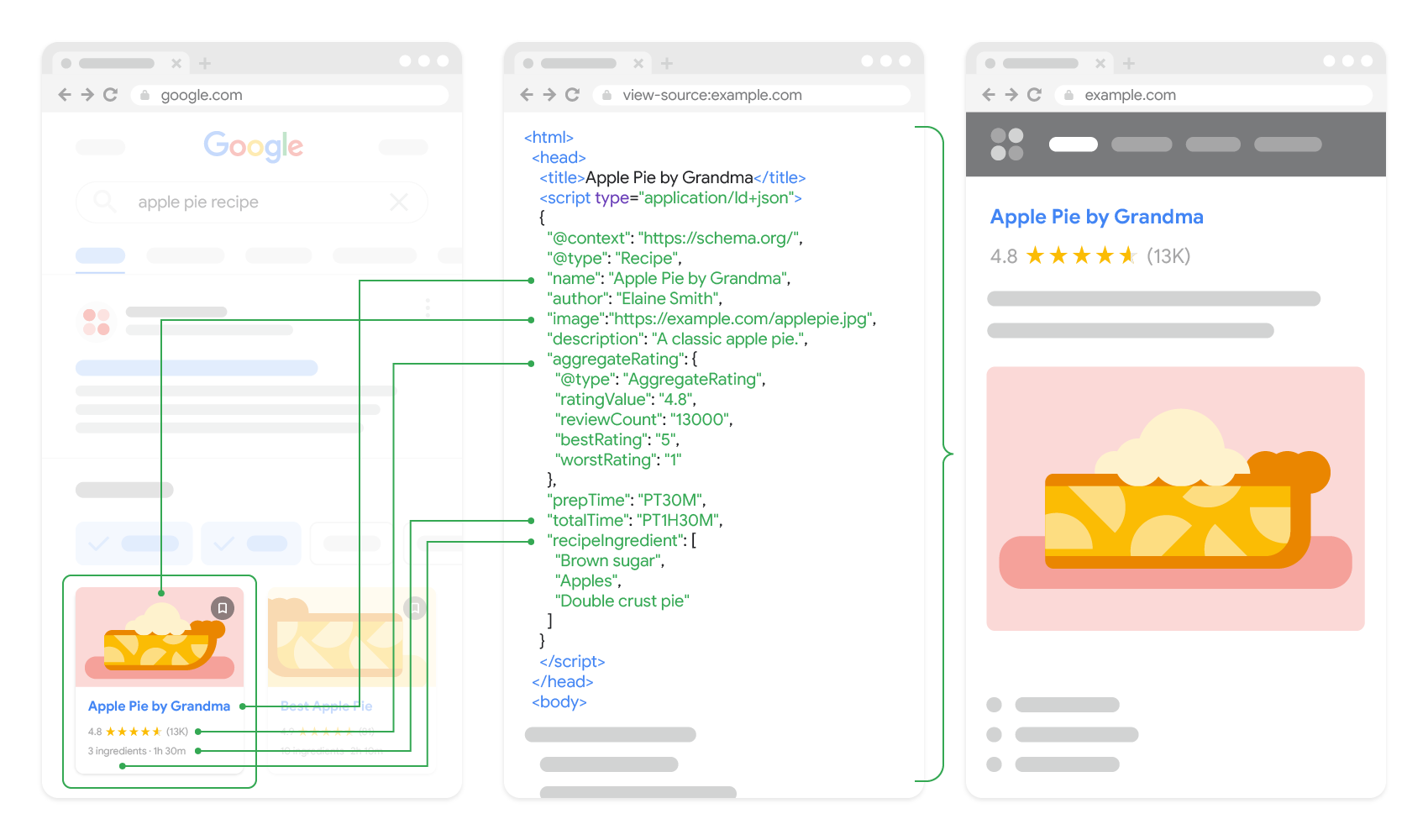
Structured data (schema markup) is a way to provide explicit information to Google about the content of your page in a format it understands. They are most commonly implemented in JSON-LD format, which is a block of code inserted into the page header.
Why does it matter? Because properly implemented structured data can lead to so-called rich results, i.e., enhanced results in search. According to Geneo, FAQ schema can increase CTR by 20% because your result takes up more space on the page and provides instant answers.
For advanced users, the concept of entity graphs, i.e., interconnected entities, is interesting. Instead of isolated blocks of schemas on separate pages, you create a connected network of entities using @graph and @id references. For example, you define an organization once and on other pages, you just refer to it. You link team members to projects, articles to topics, and services to locations. Google perceives this kind of structure as a signal of deeper authority in the given topic.
An important note: Google penalizes inconsistencies between structured data and visible content on the page. If you provide information in the schema markup that is not present on the page, you risk a manual action (penalty). Always ensure that the schema accurately reflects what the user sees on the page.
Website architecture: plan from day one
Website architecture is something that is very hard to fix afterwards. Therefore, it is ideal to think about it even before you write the first line of code or create the first page.
The basic rule is a flat hierarchy, ideally 3 to 4 levels deep. This means that from the main page, the user (and Googlebot) should reach any subpage in at most three clicks. According to Mangools, a well-designed internal linking structure increases dwell time by 25% as it makes it easier for users to discover related content.
Silo structure is a more advanced concept, where you organize content into thematic units. For example, a marketing agency may have silos for "web development," "e-commerce," and "SEO," where each silo contains a pillar article and several supporting articles that link to each other. This approach builds so-called topical authority, which Google rewards with better positions for the entire group of related keywords.
According to SEOSolved, it makes sense to limit the number of internal links on a page to 100 to 150, because excessive interlinking disperses link equity instead of concentrating it.
Local SEO: your greatest ally in the Slovak market
For small businesses in Slovakia, local SEO is often the most effective channel. According to ANRTS, optimizing your Google Business Profile (formerly Google My Business) increases visibility in the map pack by 70% for local searches.
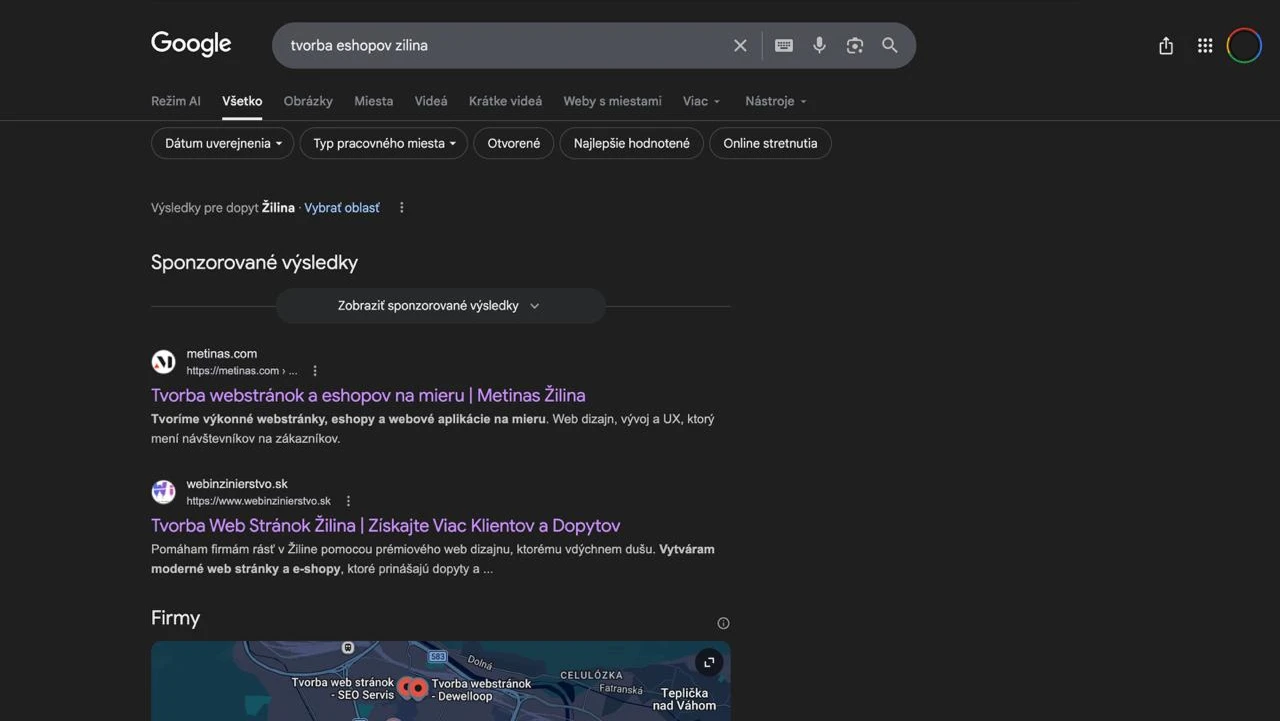
What does that mean in practice? When someone in Košice searches for "marketing agency Košice," Google shows them three results on the map before the organic results. If you are in this map pack, you gain massive visibility without having to pay for it.
Specific steps for local SEO include several areas. Fully complete your Google Business Profile including categories, opening hours, photos, and regular posts. Consistency of NAP data (name of the company, address, phone) across all directories and portals. Gathering reviews, as a profile with a rating of 4.5+ stars has demonstrably higher click-through rates. And creating locally relevant content that combines your expertise with geographic context.
According to WooAcademy, small businesses should initially target 5 to 10 long-tail keywords with a monthly search volume of 100 to 1,000 and publish 2 to 4 cluster articles a month. This consistent approach builds authority gradually and sustainably.
A practical action plan for small businesses
Theory is important, but without specific steps, it will just remain theory. Here is the order of priorities we recommend for small businesses in Slovakia.
The first month should be devoted to the basics. Register for Google Search Console and connect it to your website. Create or update your XML sitemap and robots.txt. Check if your website is fully responsive on mobile devices. Completely fill out your Google Business Profile. Identify 5 to 10 keywords to target.
The second and third months are about content. Create a pillar article for your main topic (1,500+ words, comprehensive, expert). Publish 2 to 4 supporting articles that link to the pillar article. Optimize existing pages (meta titles, descriptions, headings, internal links). Start gathering reviews on your Google Business Profile.
From the fourth month onwards, focus on growth. Analyze data in Google Search Console and identify opportunities (keywords where you are in positions 5 to 15). Build backlinks through guest posts and local partnerships. Expand content clusters on other topics. Monitor Core Web Vitals and address technical issues continuously.
According to Tronos.sk, a combination of regular content, technical optimization, and local SEO delivers measurable results for small businesses in Slovakia typically within a horizon of 3 to 6 months.
SEO is a marathon, not a sprint
SEO for small businesses in Slovakia is not about a one-time action after which you will magically appear on the first page of Google. It is a systematic, long-term process that requires consistency, patience, and a willingness to learn. But it is also one of the most profitable marketing channels because organic traffic does not stop flowing the moment you turn off your advertising budget.
Whether you are a complete beginner who just realized that seo optimization is indeed a colloquial, yet technically inaccurate term, or an experienced marketer looking for technical details for the Slovak market, the key principle remains the same. Do things right, do them consistently, and the data from Google Search Console will show you that it works.
And if you don’t have the time or capacity for it, a professional marketing agency with experience in SEO can significantly accelerate the entire process.
Technical SEO is not just about content. It’s about code.
Most marketing agencies will write you content, set up keywords, and launch ads. Yet when it comes to technical SEO, they hit a wall. Because technical SEO is not marketing. It’s development.
Crawlability, indexing, Core Web Vitals, structured data, proper URL architecture, server-side rendering, load optimization, canonical URLs, hreflang implementation. These are all issues that are not addressed in the Google Ads interface. They are addressed in the code.
And this is exactly where we come in.
We are a web agency that builds websites from scratch. We don’t pull templates from WordPress and hope it will work. We program custom solutions where technical SEO is part of the architecture from the very first line of code.
The proper structure of headings, optimized DOM, efficient loading of resources, clean URLs, and schema markup are not additional adjustments for us. They are standard components of every project.
If you already have a marketing agency taking care of the content and campaigns, we are exactly the team you need on the other side. We ensure that the technical foundation of your website does not hinder the results of their work. Because even the best content is useless if Google cannot crawl it properly, index it, and display it.




Selected projects
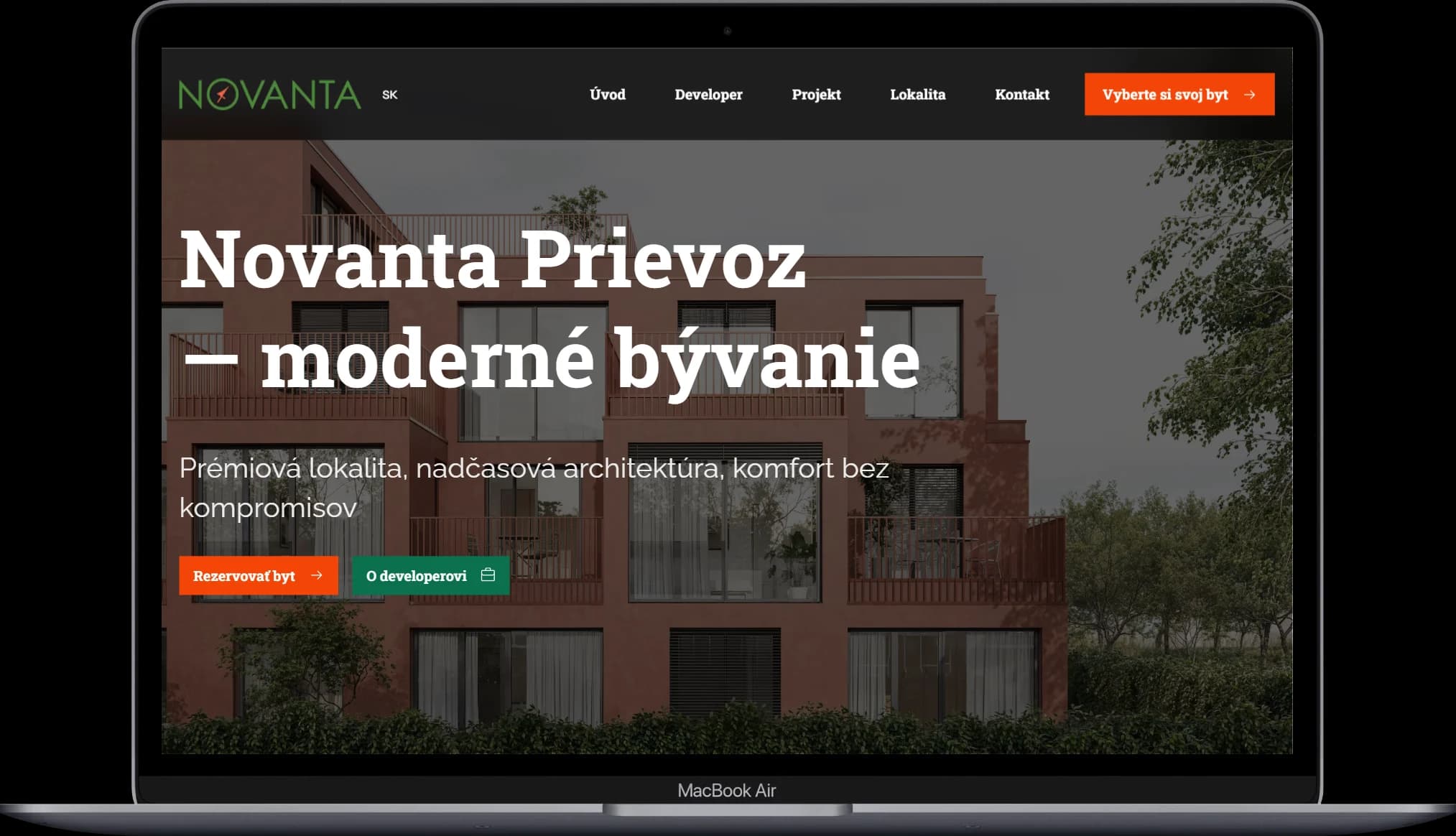
Novanta Prievoz
Category
Custom Development
Client
Proxin s.r.o.
Duration
3 weeks
Harbor Equity
Category
Website Creation
Client
Harbor Equity a.s.
Duration
2 weeks
